How long Does SEO Take to show results?One month Actually Changed
Quick Context: How long does SEO take to show results? I have one page, one month, and real Search Console data — not a benchmark study. A month ago I published a follow-up on a PVC film thickness guide I’d optimized with Surfer SEO. This is the next check-in, and I’m going to show you what one month actually moved — then be honest about how little it proves.
The numbers, one month later
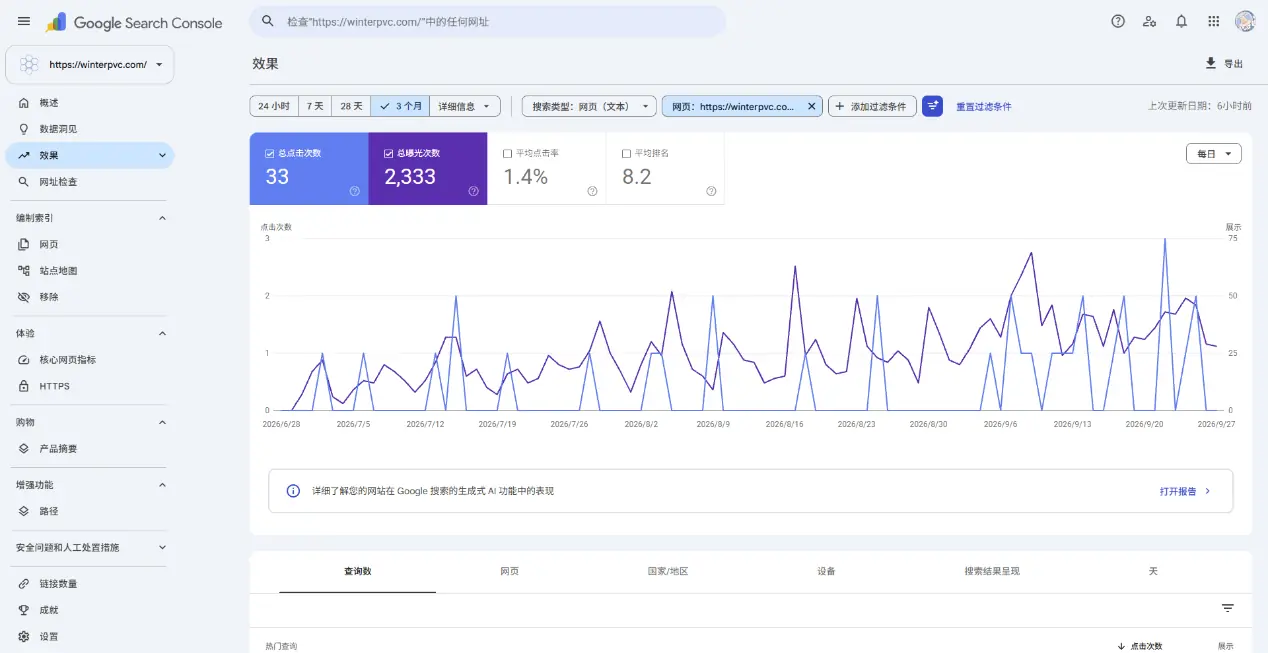
Here is the same page, measured at two points. Both are three-month windows in Google Search Console, ending on the date shown:
| Metric | Aug 31 | One month later |
|---|---|---|
| Total clicks | 14 | 33 |
| Total impressions | 1,235 | 2,333 |
| Average CTR | 1.1% | 1.4% |
| Average position | 10.1 | 8.2 |
| AI Search impressions | 209 | 497 |
One caveat on the AI row, because it moved the most of anything here: the regular Search and Generative AI numbers come from two different Search Console reports, so they aren’t directly comparable. The AI figure is its own surface, measured its own way.
On paper, that looks like a clean win. Clicks up about 136%, impressions up about 89%, CTR up a little, and average position improved by almost two places — which matters more than it sounds, because the difference between position 10 and position 8 is roughly the difference between “nobody scrolls this far” and “some people actually click.”
But there is a measurement problem I keep running into on this site, and I’d rather show it than hide it. Both rows in that table are rolling three-month windows. The Aug 31 snapshot covers roughly June through August; the new snapshot covers roughly July through September. They overlap by two months. So this is not “what changed in one month” — it is “how a three-month total looked after the window moved forward by one month.” A page that is simply growing a little each week will always look like it’s improving when you compare rolling windows this way.
So, how long does SEO take to show results?
That’s the question this page is really trying to answer, and one month gives only a partial answer. In this single case, after roughly thirty days, impressions and average position moved clearly — 1,235 to 2,333 impressions, and 10.1 to 8.2 in average position. Clicks did not move in any meaningful way. So one month was long enough to change how often the page was seen, and not long enough to change how often it was clicked.
If you came here looking for a number — “SEO takes X weeks” — I don’t have one I can defend, and I’d be suspicious of anyone who gives you a precise one. What I can tell you is what one month looked like on one page. Turning that into a timeline would take more pages, a clean before/after window, and a change log. That’s what I’m setting up for the next round.
One irony worth naming: “how long does SEO take” is exactly the kind of question AI Overviews answer directly. If a page like this one ranks there, it collects impressions without clicks — which is the pattern this post is about in the first place.
What I actually changed this month — and why I can’t tell you precisely
This is the part I’m not proud of, and it’s the most useful thing in this post.
The honest answer to “what did you change this month?” is: I don’t fully remember. I didn’t keep a change log. I optimized the page in a few sittings, added sections, edited paragraphs, and moved on — without writing down what I did, on what date, or why.
My entire record of this month’s edits is two screenshots from Surfer’s Content Editor — and they’re the only reason I can tell you anything concrete at all. They show that I built out a thickness-by-application table (furniture lamination, stationery, medical, surface protection), and that the article — a guide to choosing PVC film thickness — ended the round with a content score of 61.
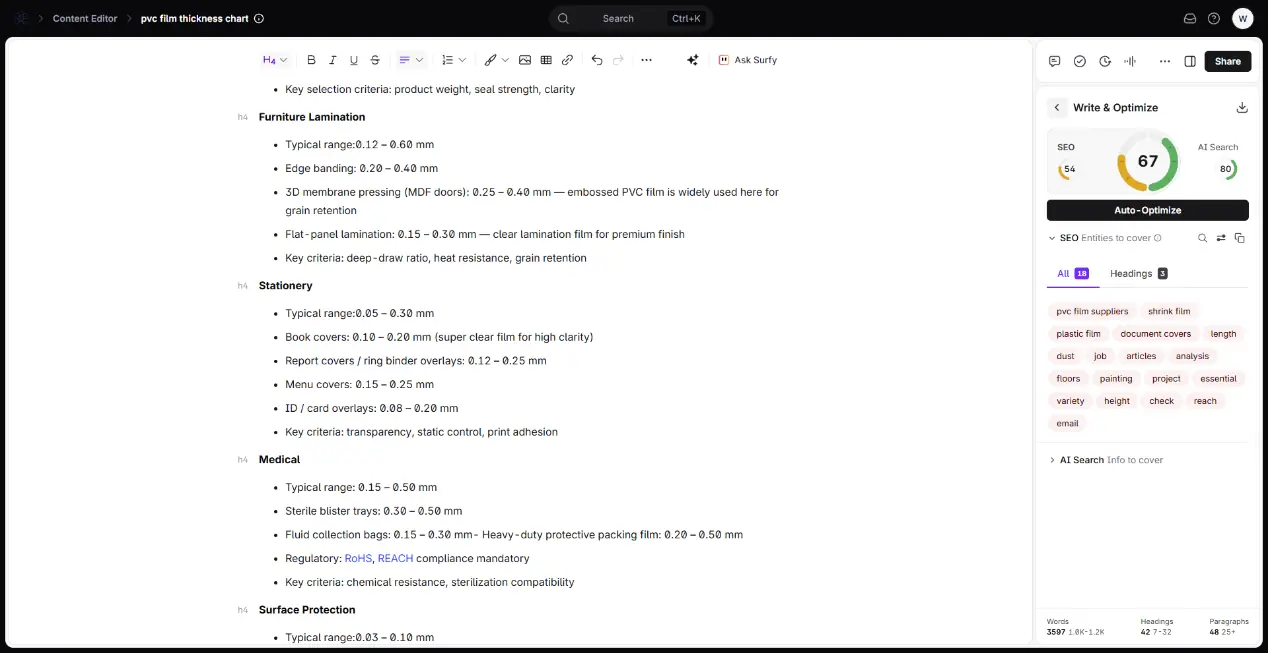
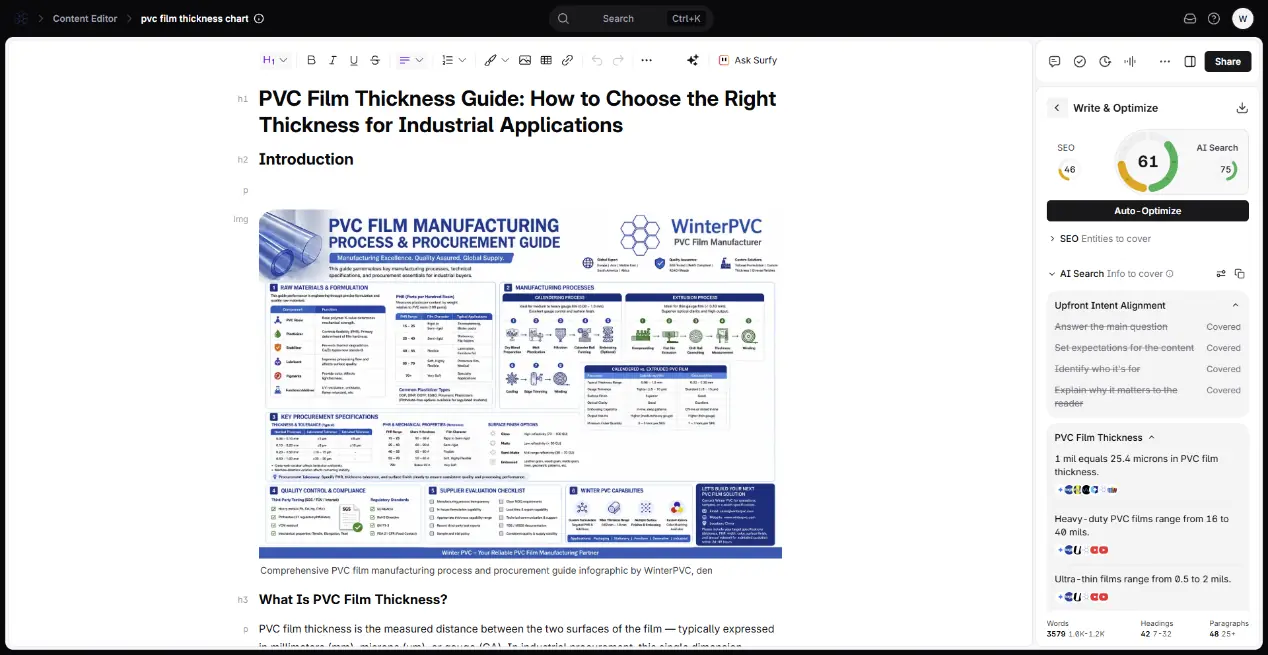
That’s it. That’s the sum of my documentation. Which means that if this page had dropped, I also wouldn’t be able to tell you what I’d done to it. An SEO experiment where you don’t record the intervention isn’t really an experiment — it’s a diary with numbers.
Why I can’t claim Surfer caused this
I’d love to write “Surfer SEO took this page from 14 clicks to 33.” I can’t, and here’s the honest version instead: at best, my optimization is one contributing factor among several.
Everything else that could explain the same numbers:
- The rolling-window problem — two overlapping three-month totals, not a month-over-month comparison.
- A new-ish page and domain still ramping up — on this site I’ve already watched a different page climb steadily from position 53 to 8 across three months with almost no intervention.
- Time itself — pages age, get crawled more, and accumulate links. That happens whether I touch them or not.
- Internal links — every time I publish or update another page that points here, this page’s numbers can move without me editing it at all.
- AI Overviews — the AI impressions figure went from 209 to 497, which sounds spectacular, but Google has been expanding AI Overviews generally this year. Some of that lift would probably have happened to any page on this site, and it comes from a separate report I can’t line up cleanly against organic clicks.
- Small numbers — 33 clicks is still a tiny sample. One good week can move a percentage like 1.1% to 1.4%.
So the defensible sentence is this: the direction is positive, the movement is consistent with the work I did, and I cannot isolate the work as the cause. That is a weaker claim than most Surfer SEO results posts make — and it’s the only one I can actually support.
Not every suggestion belongs in your post
One rule I’ve taken from this round, because I keep having to apply it: Surfer hands you a list, not an obligation. Some of what it suggests is off-topic for your business. Some is technically true but so generic that adding it makes your article less specific, not more. And some is genuinely correct — you just have to place it where a reader would expect it.
You are the only one who can make that call, because the tool doesn’t know what you manufacture. (I went through concrete examples of terms I rejected in the previous post in this series.)
What I’m changing about how I measure
Three things, all of which come directly out of the mess above:
- Keep a change log. Date, what I changed, why. A screenshot of the editor counts. If it isn’t written down, it didn’t happen — for measurement purposes, anyway.
- Stop comparing rolling windows. Use two equal-length windows, one before and one after the change, or accept that the comparison means nothing.
- Watch the metrics in the right order. CTR first, then clicks, then average position, then impressions. Impressions are the easiest number to grow and the easiest to mistake for progress.
And the simplest one: when you change a page, leave it alone for a while. Judge it after a real observation window, not the same week you edited it.
Frequently Asked Questions
How long does SEO take to show results?
In this one case, one month was long enough to move impressions (1,235 to 2,333) and average position (10.1 to 8.2), but not long enough to move clicks in any meaningful way. Thirty-three clicks across a three-month window is still a trickle. I can’t turn a single page’s month into a general timeline — and I’d distrust anyone who quotes you an exact number.
Does that mean the optimization worked?
No — it means the page improved. Both measurements are overlapping three-month windows, and factors like page age, internal links and AI Overviews could explain part of the movement. At best, the optimization is one contributing factor among several.
Do you have to add every suggestion Surfer SEO gives you?
No. Surfer gives you a list, not an obligation. Some suggestions are off-topic for your business, some are technically accurate but so generic that they dilute a specific page, and some are genuinely worth adding. You need product knowledge to sort them — the tool doesn’t know what you actually manufacture.
What did you change on the page this month?
The one change I can still document is a thickness-by-application table covering furniture lamination, stationery, medical and surface protection. Honestly, I didn’t keep a change log, so I can’t reconstruct every edit — and that’s the main process lesson from this round: without a record of the intervention, you can’t attribute the result.
What metrics should you watch first after optimizing a page?
CTR first, then clicks, then average position, then impressions. Impressions are the easiest metric to grow and the easiest to mistake for progress, because a page can collect impressions from broad, low-intent queries without earning a single extra click.
Why can’t you compare two three-month windows?
Because they overlap. An Aug 31 three-month total covers roughly June through August, and a one-month-later total covers roughly July through September — two of the three months are shared. A page that grows slightly every week will always look like it’s improving when you compare rolling windows. Use two equal-length windows instead: one entirely before the change, one entirely after.
What’s next
I’ll check this page again at the end of next month — this time against a proper before/after window, with a change log I actually kept. If CTR keeps moving in the right direction, that’s a more meaningful signal than impressions ever were. If it flattens, that’s useful information too, and I’ll write about that version just as plainly.
This is the third post in the series. If you want the full picture, start with the Surfer SEO review that kicked it off.