Surfer SEO Review: I Used It to Optimize My B2B PVC Website’s Content — Here’s What Actually Happened
Quick Context: In this honest Surfer SEO review, I share how a 19-year-old with zero SEO experience optimized a real site. Two months ago, I started winterpvc.com — a B2B export site for PVC film — to learn by doing. After finding fixes via SE Ranking, I put Surfer SEO to a real test on an actual product guide that buyers land on. This post is now the full written record of that test: the conditions, the raw numbers behind every screenshot, and — just as importantly — the things that did not move.
Here is the whole Surfer SEO Review catalog:
- First: Test conditions and baseline
- Second: Raw Data — the content audit numbers
- Third: What changed — the full before/after table
- Fourth: Surfer’s score vs. what actually moved in search
- Fifth: What did NOT change
- My Honest Take
- What I will track next
- Conclusion
First: Test conditions and baseline
Before any conclusions, here is exactly what was tested, on which page, over which dates, and with which tool tier. If you want to reproduce or challenge anything in this post, this table is where to start.
| Item | Value |
|---|---|
| Page under test | winterpvc.com/pvc-film-thickness-guide/ |
| Page title | PVC Film Thickness Guide: How to Choose the Right Thickness for Industrial Applications |
| Page type | Product-support guide page (not a product page, not a blog post) |
| Optimization went live | 2026-08-31 |
| Regular Search window | 2026-05-29 → 2026-08-28 (3 months, Google Search Console) |
| Keyword-level window | 2026-07-30 → 2026-08-28 (Surfer Content Audit) |
| Generative AI window | 2026-06-06 → 2026-08-31 (3 months, GSC Generative AI report) |
| Metrics tracked | Surfer Content Score (SEO + AI Search), clicks, impressions, CTR, average position, Generative AI impressions, keyword-level position and impressions |
| Tool tier | Surfer SEO Discovery plan ($49/mo, billed yearly) |
| Scope of changes | On-page content and metadata only. The URL, the page template and the site structure were not changed — so there is no redirect or migration effect mixed into these numbers. |
Here is the baseline — three months of Search performance for that single page, pulled on 2026-08-31, before I touched anything:
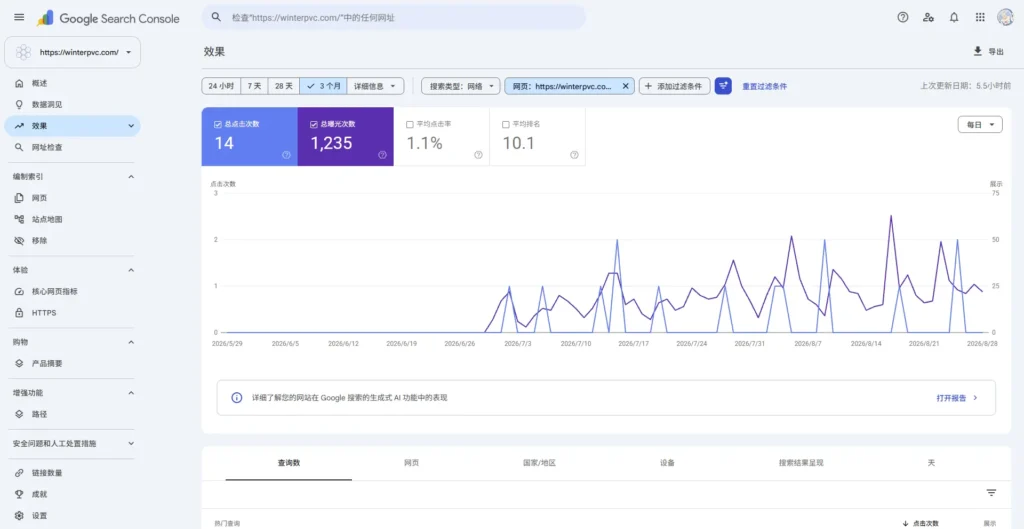
Although it is shown in Chinese, we can still see that Total Clicks is 14, Total Impressions is 1,235, Average CTR is 1.1%, and Average Position is 10.1 over 3 months.
| Metric | Baseline value | Source report |
|---|---|---|
| Total clicks | 14 | Search performance |
| Total impressions | 1,235 | Search performance |
| Average CTR | 1.1% | Search performance |
| Average position | 10.1 | Search performance |
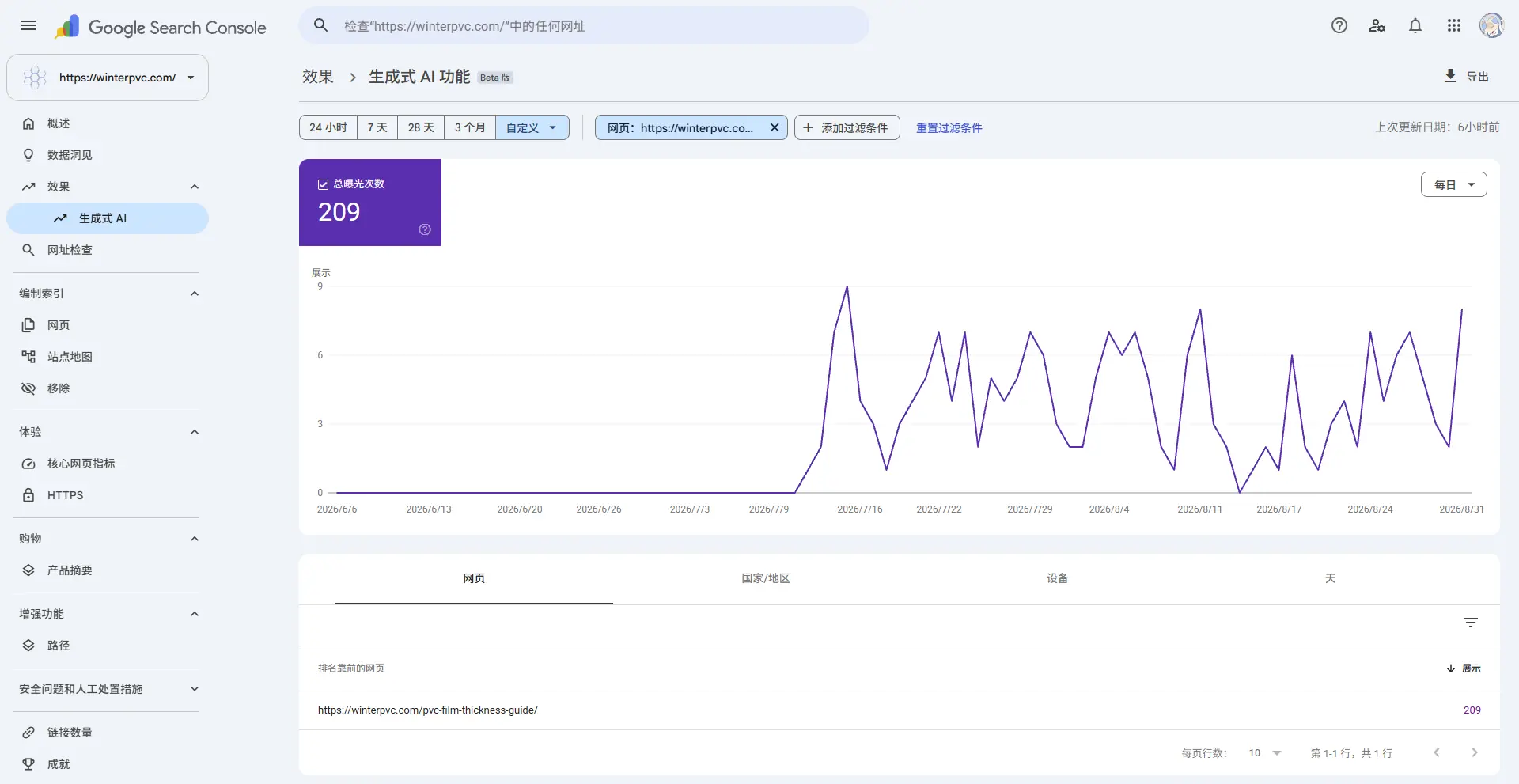
| Generative AI impressions | 209 | Generative AI (Beta) |
Average position 10.1 is the number that decided the whole experiment. Position 10 is exactly the boundary between page one and page two, and the page had been sitting on it for three months. If I could move it further, it might reach page one.
Second: Raw Data
When I selected the article, Surfer indicated that I had to change the main keyword. So, I chose “pvc film thickness chart” as the main keyword instead.
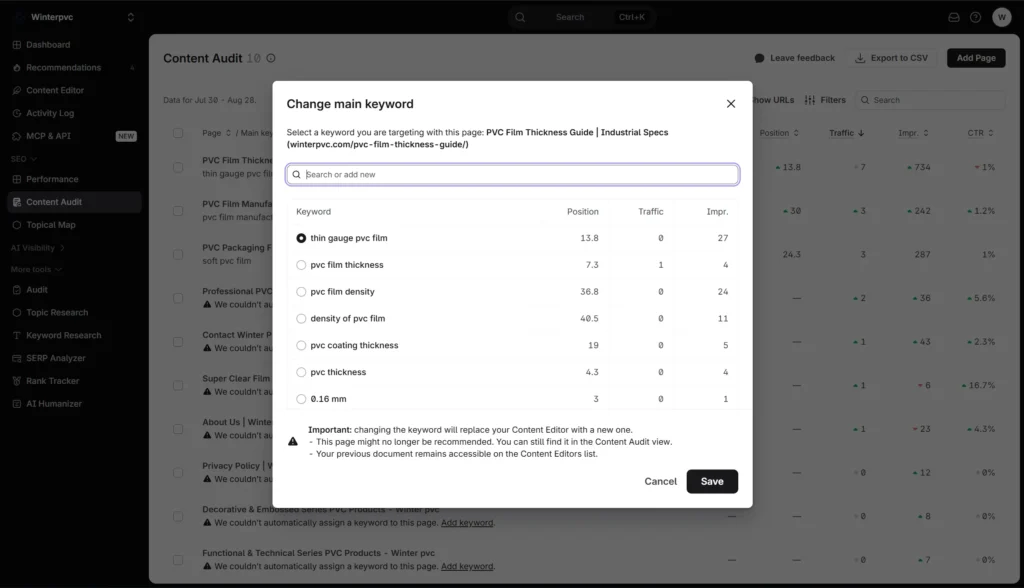
That dialog is more useful than it looks, because it is the only place where I can see keyword-level reality next to the tool’s own suggestion. Surfer pulled this list from GSC data covering 2026-07-30 → 2026-08-28. I typed it out in full below, including the rows where the numbers are nearly zero — those matter as much as the good ones:
| Keyword | Position | Clicks | Impressions | Status |
|---|---|---|---|---|
| thin gauge pvc film | 13.8 | 0 | 27 | Surfer’s first suggestion — rejected (too narrow) |
| pvc film thickness | 7.3 | 1 | 4 | My original target — Surfer refused to analyze it |
| pvc film density | 36.8 | 0 | 24 | Off-topic for this guide |
| density of pvc film | 40.5 | 0 | 11 | Off-topic for this guide |
| pvc coating thickness | 19 | 0 | 5 | Adjacent — kept an eye on it |
| pvc thickness | 4.3 | 0 | 4 | Best position, almost no volume |
| 0.16 mm | 3.0 | 0 | 1 | One impression. Kept it in the notes anyway. |
Two things jump out of this list. First, the page ranks best (position 3.0 and 4.3) for keywords that almost nobody searches — while the keyword driving most of its impressions (“thin gauge pvc film”, 27 impressions) sits at position 13.8. Second, the main keyword I ended up choosing does not appear in this list at all. I will come back to that in the next two sections, because it turned out to be the most useful thing I learned from this whole test.
Before I could even run the audit properly, Surfer flagged an issue: the keyword I originally wanted — “pvc film thickness” — had search results “dominated by a single domain,” so it refused to analyze. I later found out a competitor, Linyang Plastics, held two of the top five spots for that term. I also tried letting Surfer suggest a new main keyword (“thin gauge pvc film”), but after checking my article, I realized this narrowed the topic too much — my guide actually covers the full 0.05mm–3.0mm range, not just thin films. So I stuck with a more specific long-tail keyword instead: “pvc film thickness chart.”
Third: What changed — the full before/after table
I picked the article titled “PVC Film Thickness Guide: How to Choose the Right Thickness for Industrial Applications”. Here is the initial score:
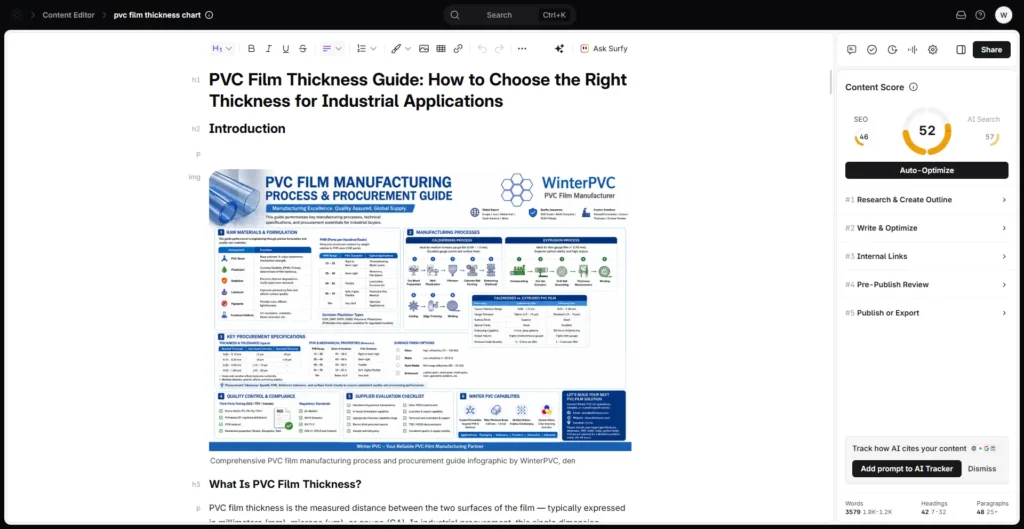
It showed an SEO score of 46 and an AI search score of 57, resulting in an overall score of 52.
I clicked “#2 Write & Optimize”, which showed potential keywords I hadn’t used yet and how my article was being quoted in AI search. After optimizing, the score rose to 58.
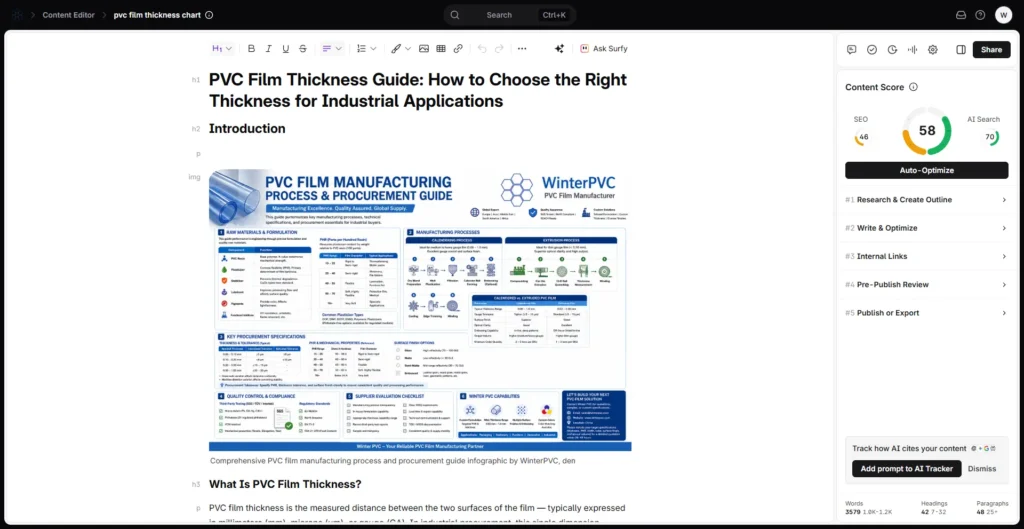
Instead of describing the changes loosely, here is the item-by-item record. Every row is taken directly from the two screenshots above or from the audit dialog — nothing here is estimated:
| Item | Before (2026-08-31) | After (2026-08-31) | Change |
|---|---|---|---|
| Main keyword | pvc film thickness (analysis refused by Surfer) | pvc film thickness chart | Replaced with a long-tail term |
| Content Score (total) | 52 | 58 | +6 |
| SEO score | 46 | 46 | 0 |
| AI Search score | 57 | 70 | +13 |
| Words | 3,579 | 3,579 | 0 |
| Headings | 42 | 42 | 0 |
| Paragraphs | 48 | 48 | 0 |
That last group of rows is the part nobody expects. The word count did not change at all. Same 3,579 words, same 42 headings, same 48 paragraphs — and yet the score went up 6 points, entirely through AI Search. Whatever this first cycle improved, it was not length. It was how clearly the existing text answers questions and matches search entities. I spent the money expecting to be told “write more,” and instead the useful instruction was “say what you already say, in the language people actually search with.”
Fourth: Surfer’s score vs. what actually moved in search
This is where a score and a ranking report start telling different stories. Surfer’s total score moved 52 → 58, which reads like a 12% improvement. Here is what happened in Google over the same period, with Generative AI data pulled again on 2026-09-08:
| Signal | Before | After | Reading |
|---|---|---|---|
| Surfer Content Score | 52 | 58 | +6 points |
| Average position | 10.1 | 9.9 | Effectively flat — still on the page-one boundary |
| Clicks | 14 | 15 | +1 click in three months |
| Generative AI impressions | 209 | 238 | +29 (roughly +14%) |
The honest summary: the score improved, the clicks did not, and the AI-side number did. The two Surfer scores moved in different directions for different reasons — AI Search jumped 13 points while SEO stayed at 46 — and the only external number that actually moved in the same direction was Generative AI impressions. If I had only looked at the Content Score, I would have assumed “12% better.” If I had only looked at clicks, I would have assumed “nothing happened.” Both are true at once, which is exactly why I now log them in the same table instead of trusting one.
The second, more uncomfortable finding is about the main keyword itself. “pvc film thickness chart” — the keyword I locked in as the main target — receives zero recorded impressions on this page. The 27 impressions that anchor the page’s visibility go to “thin gauge pvc film,” which is the suggestion I rejected for being too narrow. So the page is being found through a cluster of related phrasings rather than the one term the tool asked me to commit to. For a small B2B site, that reframes what a “main keyword” is for: it is a reporting anchor inside the tool, not the mechanism that brings traffic.
Fifth: What did NOT change
I am writing this section deliberately, because most “I ran a tool on my site” posts only report movement. Here is the list of things that stayed flat, with the data behind each one:
- Word count: 3,579 before, 3,579 after. Zero added words.
- SEO score: 46 before, 46 after. The first optimization cycle did not move the SEO component at all.
- Average position: 10.1 → 9.9. A change of 0.2 positions over three months is not a ranking movement, it is measurement noise.
- CTR: 1.1% → 1%. Flat, and if anything marginally down.
- The page is still not on page one. Position 9.9 is the edge of page one, not inside it. The original goal — “if I optimize it further, it might reach page one” — has not been achieved yet.
- Click growth: 14 → 15 clicks. One extra click. I am not going to build a narrative on one click.
There is a plausible explanation for the flatness that I want to state as a hypothesis rather than a conclusion: the impressions figures come from two 3-month windows that are shifted by about eight days (2026-05-29 → 2026-08-28 versus 2026-06-06 → 2026-09-05), so part of the +236 impressions is simply “a different three months,” not necessarily new visibility. Impression growth without click growth is a known pattern for informational B2B pages — you get shown, but the searcher finds what they need in the description. I cannot separate those effects with the data I have.
My Honest Take
Which Surfer SEO plan is worth paying for
I tested Surfer SEO using the “Discovery” plan, but this plan does not grant access to the full suite of features, such as running an AI audit across your entire website. If you want that feature, you need to upgrade to the Pro version. Here is a table showing the differences and my advice between the four plans:
| Plan | Price | Best For | Key Features |
|---|---|---|---|
| Discovery | $49/mo(Billed yearly) | Individual creators or early-stage small projects | Offers essential content generation and optimization tools without AI model visibility tracking. |
| Standard | $99/mo(Billed yearly) | Single-brand marketing | Introduces ChatGPT brand citation and mention tracking (25 Prompts with weekly updates) and expands team seats to 3. |
| Pro | $182/mo(Billed yearly) | Multi-brand or agency teams | Supports daily tracking across all major AI models (ChatGPT, Perplexity, Gemini, AI Overviews, etc.) and allows managing up to 5 brand workspaces. |
| Peace of Mind | $299/mo(Billed yearly) | Large enterprises | Unlocks unlimited AI documents and workspaces, provides 100 daily AI prompt tracking slots, and serves as the only tier with API access. |
For a solo operator like me, Discovery is enough if you’re just optimizing content page by page — which is honestly most of what a small B2B site needs early on. I don’t think most beginners need to jump to Standard or Pro right away; the AI visibility tracking features are clearly built for teams managing multiple brands, not someone auditing their own site.
The suggestions I chose not to take
One critical lesson I learned: AI tools are advisors, not decision-makers. Throughout the audit, Surfer suggested keywords that didn’t fit reality — like narrowing my main keyword to “thin gauge pvc film” (which covers only 0.05–0.25mm, whereas my guide covers the full 0.05–3.0mm range), or recommending irrelevant terms like “South PVC films”. Two more suggestions I chose not to take, and why:
| Suggestion | Decision | Reason |
|---|---|---|
| thin gauge pvc film (as main keyword) | Rejected | Covered only 0.05–0.25mm, but the guide covers 0.05–3.0mm. Using it would have narrowed the page’s scope below its actual content. |
| South PVC films | Rejected | Not a real product category in our catalogue. Writing about it to satisfy a term would have been factually wrong. |
| shrink film | Rejected | Technically a type of PVC film, but not something we manufacture. The search intent behind the term does not match what we sell. |
| plastic film | Rejected | True but far too broad. It would have diluted a page that is specifically about gauge charts and tolerance standards. |
Instead of blindly following every AI recommendation, I filtered everything through actual B2B product knowledge. AI can spot search patterns, but human judgment ensures the content stays accurate to your real business.
What I will track next
Based on what this first cycle showed — score up, clicks flat, AI impressions up — these are the specific things I am watching, and the hypothesis behind each one:
- Whether the AI Search gain converts into anything: AI impressions went 209 → 238 while clicks stayed flat. Hypothesis: AI visibility reaches searchers who never click, so I should stop judging this page by clicks alone.
- Whether a second optimization cycle moves the SEO score off 46: the first cycle left it untouched, which suggests the remaining gap is structural (heading coverage, entity completeness) rather than lexical.
- Whether “thin gauge pvc film” keeps carrying the page: it holds the most impressions (27) at the weakest position (13.8). If its position improves, the page has a real ranking gain; if not, the impression growth is coming from somewhere else.
- Whether the main keyword ever starts reporting: “pvc film thickness chart” currently returns nothing for this page. If it stays at zero, I will stop treating a single main keyword as the target metric.
- Whether a longer window changes the picture: I will re-pull both reports with an identical window length (three full months) so that window drift stops contaminating the comparison.
Data reproducibility note
Everything in this post comes from three sources that anyone with access to the site can re-check. Surfer numbers were captured on 2026-08-31 from the Content Audit and Content Editor (data window 2026-07-30 → 2026-08-28). Google Search Console numbers were pulled on 2026-08-31 (window 2026-05-29 → 2026-08-28) and again on 2026-09-08 for the Generative AI report (window 2026-06-06 → 2026-08-31). The optimization itself went live on 2026-08-31, so any measurement taken before that date is a baseline, not a result. Regular Search performance and the Generative AI performance report are two separate reports measuring different things, and I have kept them labelled as such in every table above instead of merging them into one “traffic” number. Where a figure is a single data point (like the 0.16 mm keyword with one impression), I have said so rather than letting a table imply significance it does not have.
Conclusion
Surfer SEO’s content audit tool can analyze not only your specific article but also the context of other pages, which is very helpful for anyone who doesn’t know where to start with auditing and optimizing. It also told me something I did not expect: the first thing worth fixing on this page was not length — the word count never changed — but how explicitly the existing 3,579 words answer the questions people actually type. The score moved 52 → 58 while clicks stayed at 14 → 15, and I would rather publish both numbers than pretend only one of them exists. Over the coming weeks, I will keep tracking the performance in Google Search Console and share my honest thoughts on this SEO tool.
If you want to try auditing your own site, you can check out Surfer SEO here. Thank you for reading.
Frequently Asked Questions
A few questions I keep getting about this experiment, answered directly:
Did Surfer SEO actually improve my rankings?
Not measurably yet. The Content Score moved from 52 to 58, but clicks went from 14 to 15 and average position went from 10.1 to 9.9 over the same period. The only external number that moved noticeably was Generative AI impressions, from 209 to 238.
Why did the word count not change if the content was optimized?
Because the first optimization cycle was not about length. Both screenshots show 3,579 words, 42 headings and 48 paragraphs, so the 6-point gain came from how the existing text answers questions and matches search entities, not from adding text.
Should I use the main keyword that Surfer SEO suggests?
Not blindly. Surfer suggested “thin gauge pvc film”, which only covers 0.05-0.25mm, while my guide covers the full 0.05-3.0mm range, so I chose “pvc film thickness chart” instead. That keyword currently earns zero recorded impressions, while most of the page’s impressions go to “thin gauge pvc film”.
Which Surfer SEO plan do I need as a solo operator?
For a solo operator optimizing one page at a time, the Discovery plan at $49 per month billed yearly is enough. It does not include a site-wide AI audit, and the AI visibility tracking in Standard and Pro is built for teams managing multiple brands.
How long should I wait before judging the result of an optimization?
Longer than nine days. Nine days and fewer than 1,500 impressions is a small sample, so I did not claim the tool worked or did not work. I will re-pull both Search Console reports with an identical three-month window before drawing any conclusion.