Frase Review: I Ran It Against Surfer SEO on the Same Page – Here’s What Each One Told Me
Quick Context: This is a hands-on Frase review, but not the usual kind. I’ve been using Surfer SEO for about a month, on one page of my B2B site, so instead of judging Frase in isolation, I ran the same page through it to see what a second tool would tell me. A month ago I wrote up what actually happened after the Surfer optimization; this post is about the difference between the two tools. It won’t tell you which tool caused my rankings to move — it tells you how differently they advise you.
Some links in this post are affiliate links. If you subscribe, I may earn a commission at no extra cost to you.
Background: the page I’m testing
The page is a PVC film thickness guide on winterpvc.com. After I optimized it with Surfer SEO, the page’s numbers moved: over a three-month window it now sits at 33 clicks, 2,333 impressions, a 1.4% CTR and an average position of 8.2. Whether Surfer caused that is a separate question, and I deal with it further down.
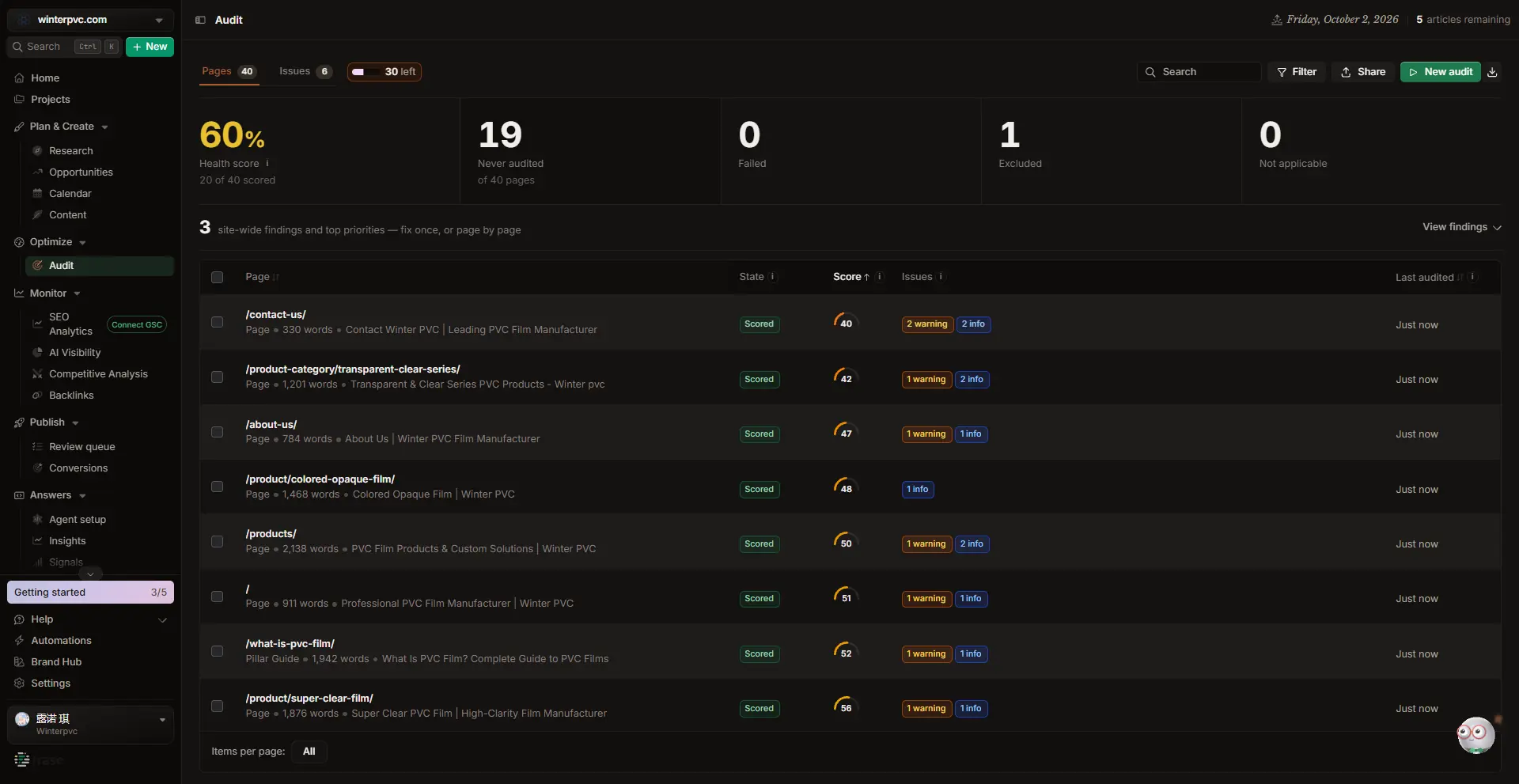
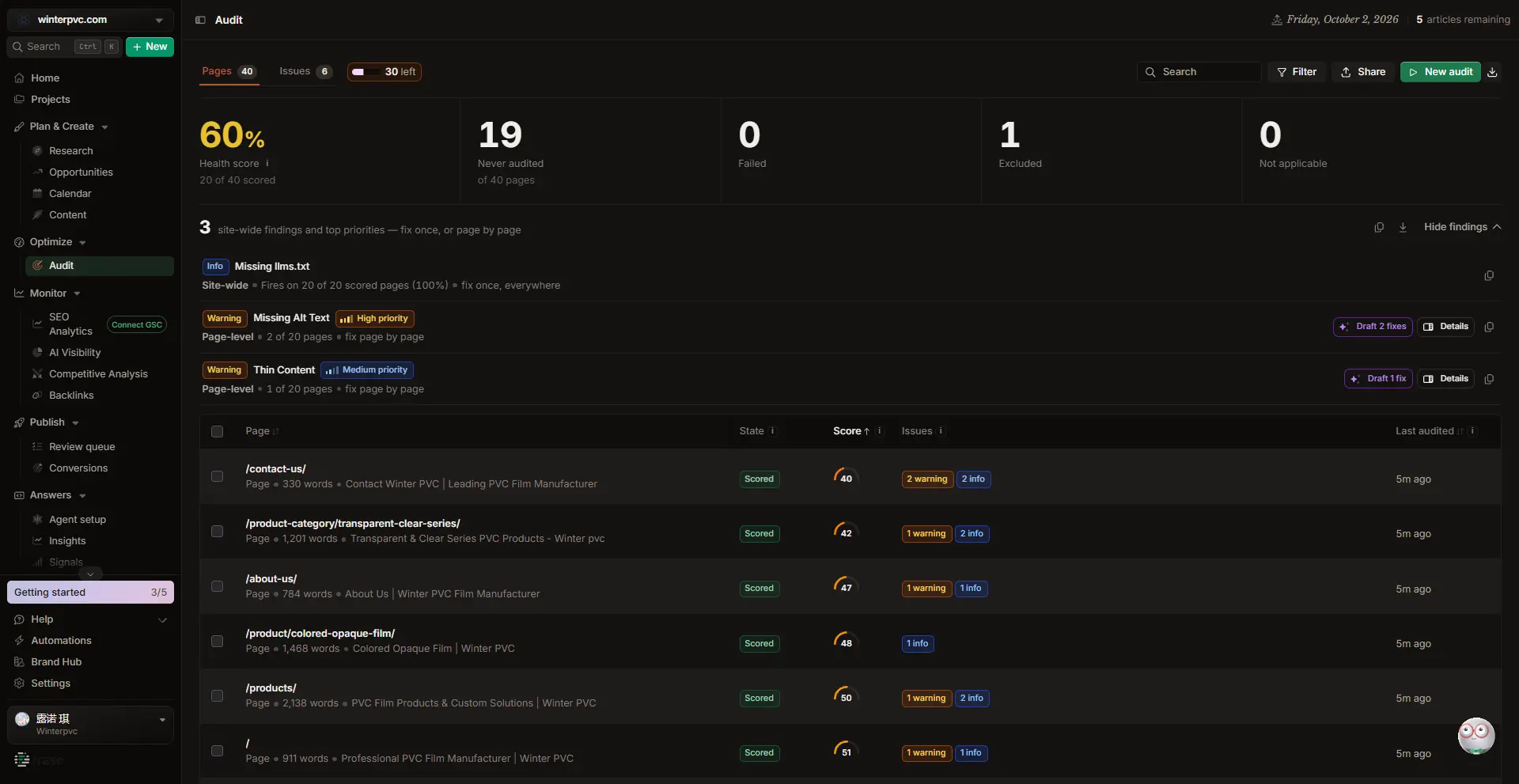
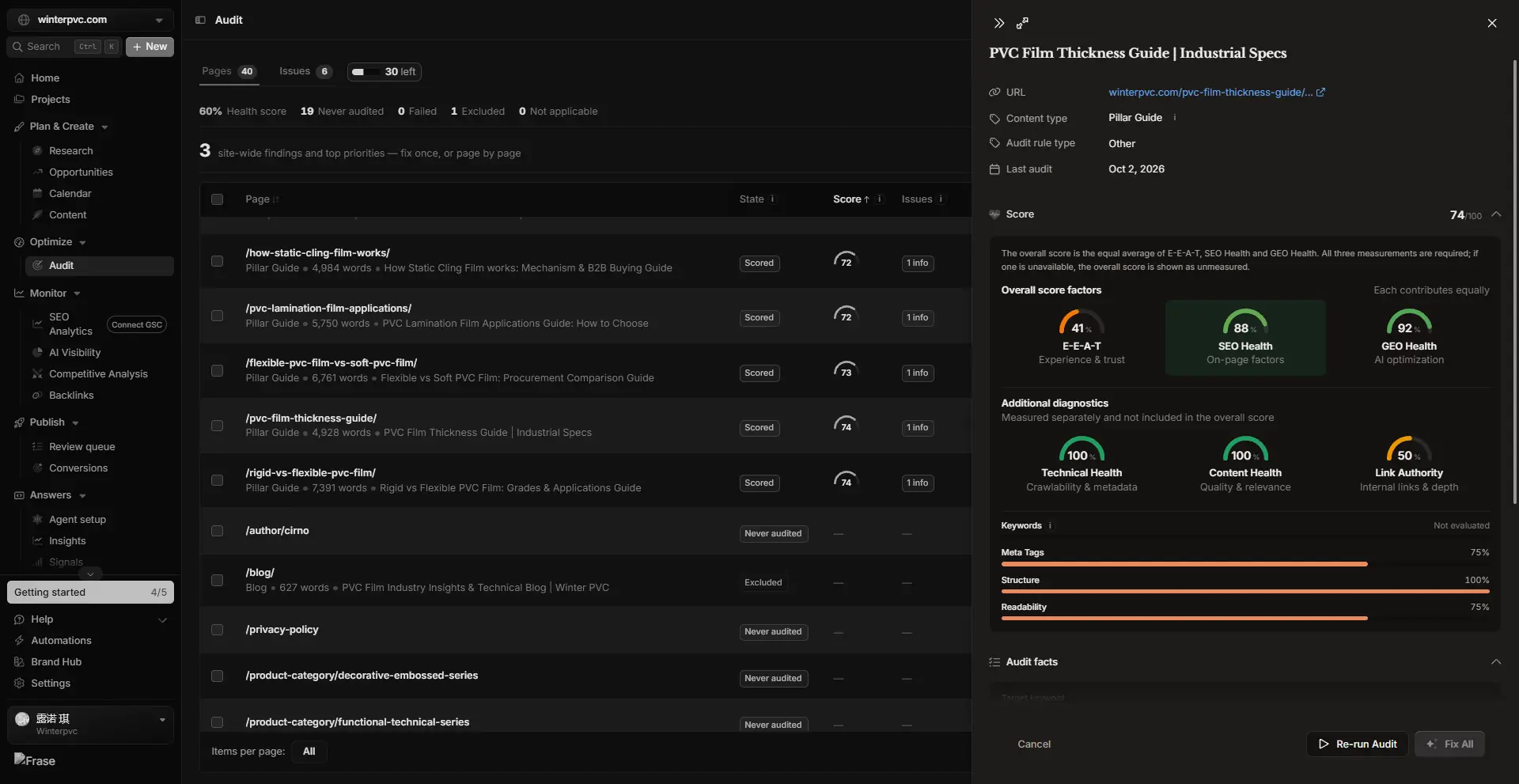
Before writing this Frase review, I ran Frase’s site audit. It graded the site with a health score of 60% across 40 pages, and surfaced 3 findings. Two are worth naming:
- Missing alt text — this fires on 20 of 20 scored pages (100%). That’s a site-wide problem, not a page-level one, which makes it cheap to fix once and expensive to keep ignoring.
- Thin content — flagged across 20 pages. In other words, a large share of my site still needs real work.
What Frase does before you write anything
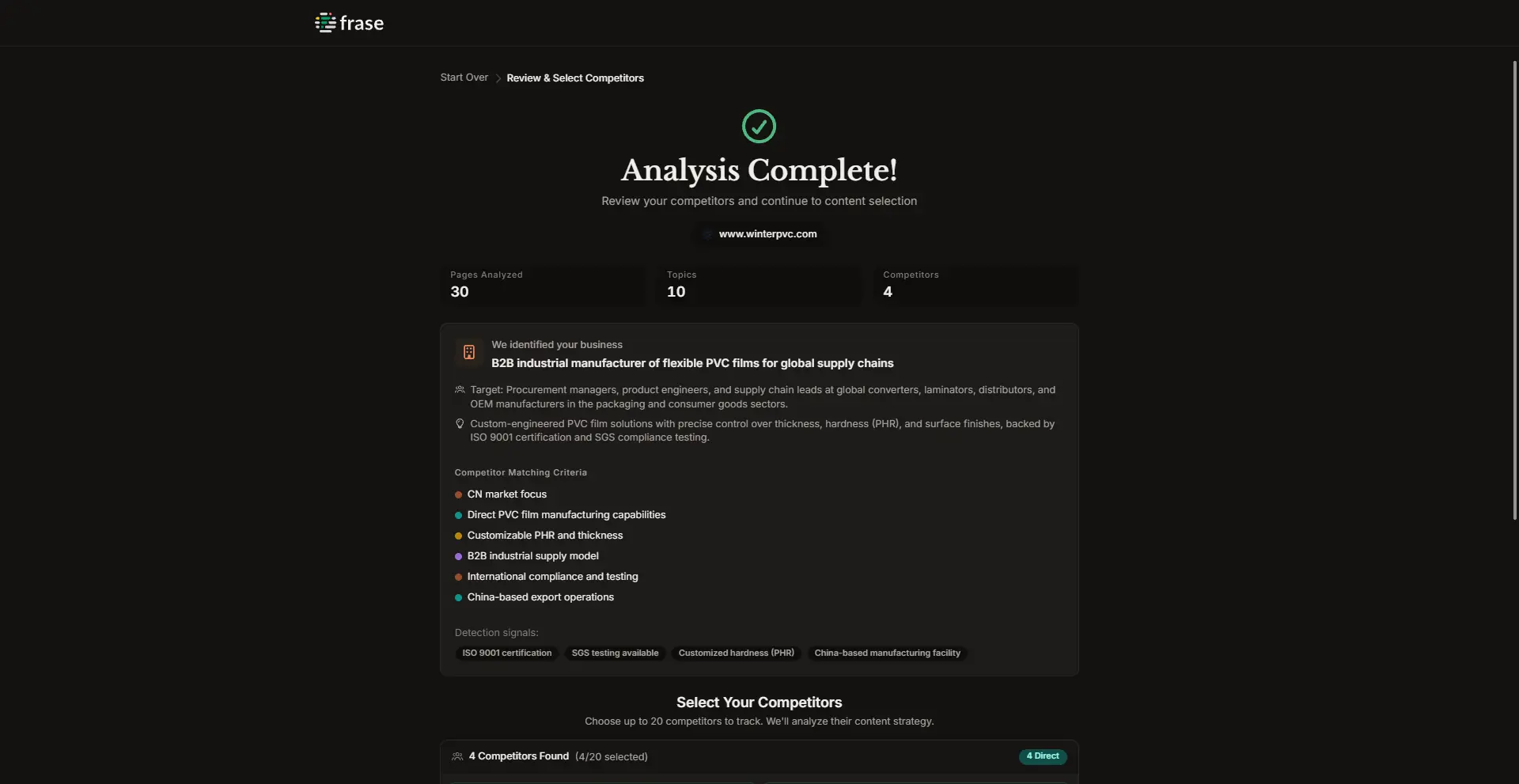
Frase starts by asking for your URL. From there it identified my business on its own: “B2B industrial manufacturer of flexible PVC films”, with ideal customers described as purchasing managers, product engineers and supply chain managers.
That automatic read is the first thing this Frase review has to judge.
It then generated its own matching criteria and detection signals: CN market focus, direct PVC film manufacturing capability, customizable PHR and thickness, a B2B industrial supply model, and ISO 9001 / SGS compliance.
My honest read: that’s a genuinely accurate summary of what my site is, and it’s a reasonable starting point for advice. But it is still a machine’s guess. You are the one who has to confirm what your business actually is — especially if your site, like mine, sells into a niche that most training data handles badly.
Frase’s competitor matching: two dead domains and a company that isn’t in my industry
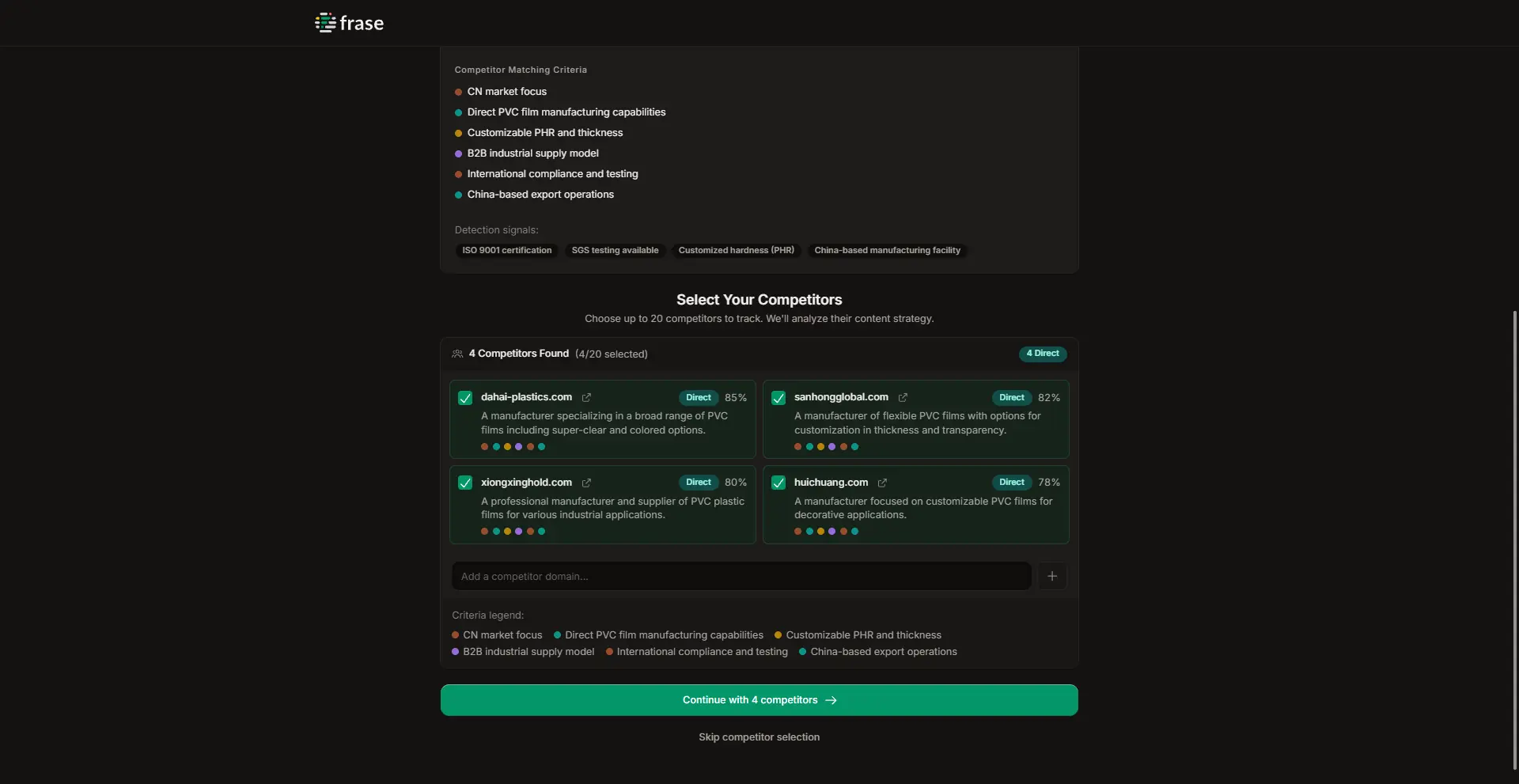
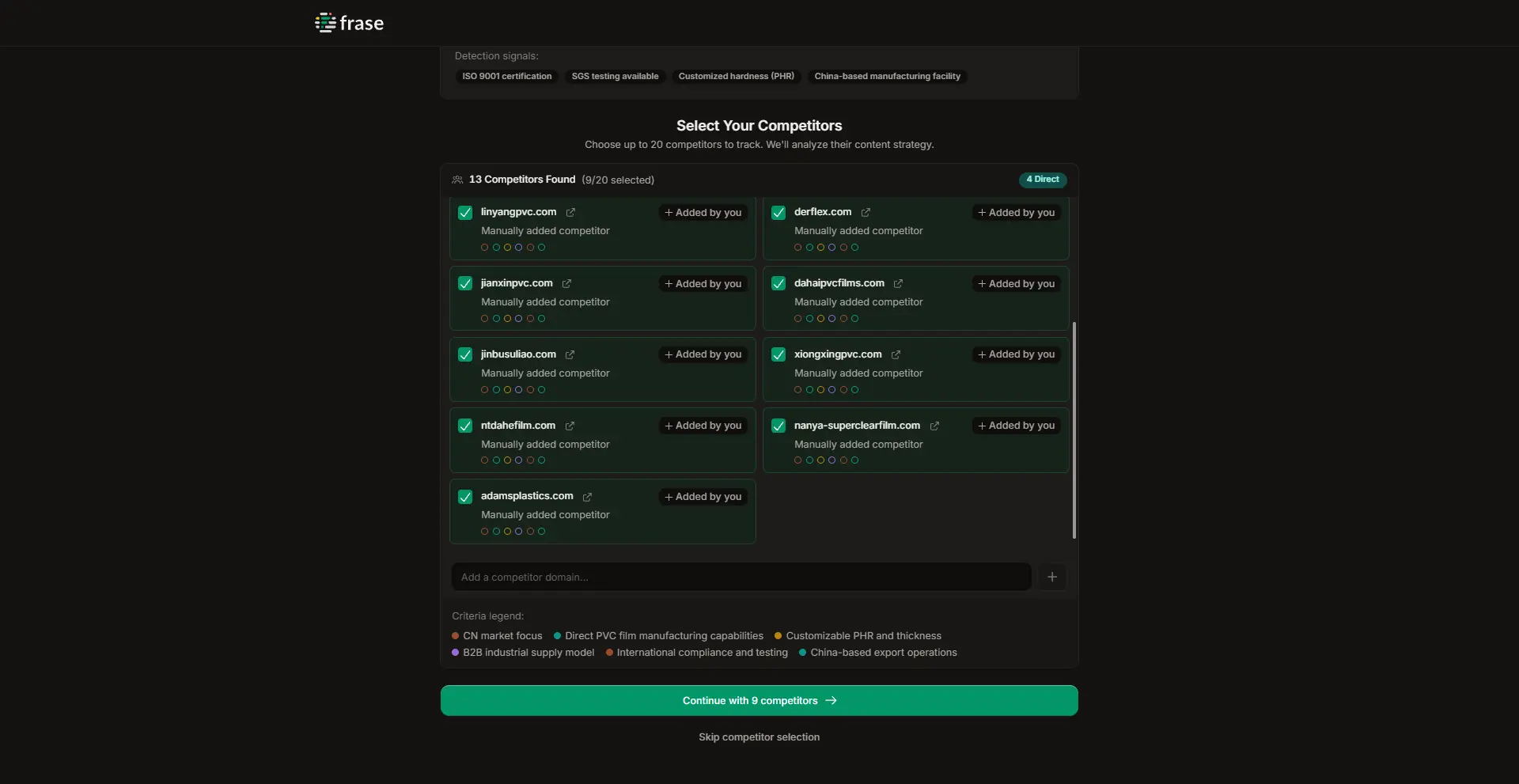
Frase suggested four competitors, scored 85%, 82%, 80% and 78% for match — and this is the part of the Frase review I’d flag most loudly. I opened each one by hand, one at a time. The result:
- Two of the domains no longer resolve at all — they’re dead.
- One of them, matched at 85%, turned out to be a Henan company selling fresh-keeping film, paper tubes and steel pipes. Nothing to do with PVC film.
So I did the matching myself. I used search engines to find living, relevant competitors and manually added nine real B2B competitors — including linyangpvc.com, derflex.com, dahaipvcfilms.com, xiongxingpvc.com, ntdahefilm.com, nanya-superclearfilm.com (Nan Ya Plastics, one of the largest PVC film producers in the world) and adamsplastics.com.
This is the part I’d underline for anyone evaluating this class of tool: a 85% match score does not mean the site is alive, and it does not mean the site is in your industry. Check every domain before you trust the analysis built on top of it.
The direct comparison: Surfer vs Frase on the same page
For this Frase review I used the same target keyword I’d used with Surfer, and let both tools analyze the identical page. Here’s what each one told me.
| Surfer SEO | Frase SEO | |
|---|---|---|
| Overall score | Content score 61 | Overall 69% |
| Score breakdown | One combined number | EEAT 38% / GEO 85% / SEO 84% |
| Form of advice | Entity list — opaque PVC film, vinyl film, thermoplastic material, shower curtains… | SERP-driven “Topics to cover” + “Questions to answer” |
| Extra diagnostics | — | Meta tags 75% / structure 100% / readability 75% / link authority 50%; 3,695 words, 53 headers, 22 links |
1. What each tool measures. Surfer gives one content score: 61. Frase gives an overall score of 69% — and then breaks it into EEAT 38%, GEO 85% and SEO 84%.
That breakdown is the single most useful thing this Frase review turned up. My SEO signals are fine (84%) and the page is highly extractable for AI systems (GEO 85%). What’s actually weak is EEAT — 38%. In other words, my problem isn’t keyword coverage; it’s authority and experience signals. Surfer never surfaced that, because it doesn’t try to measure it.
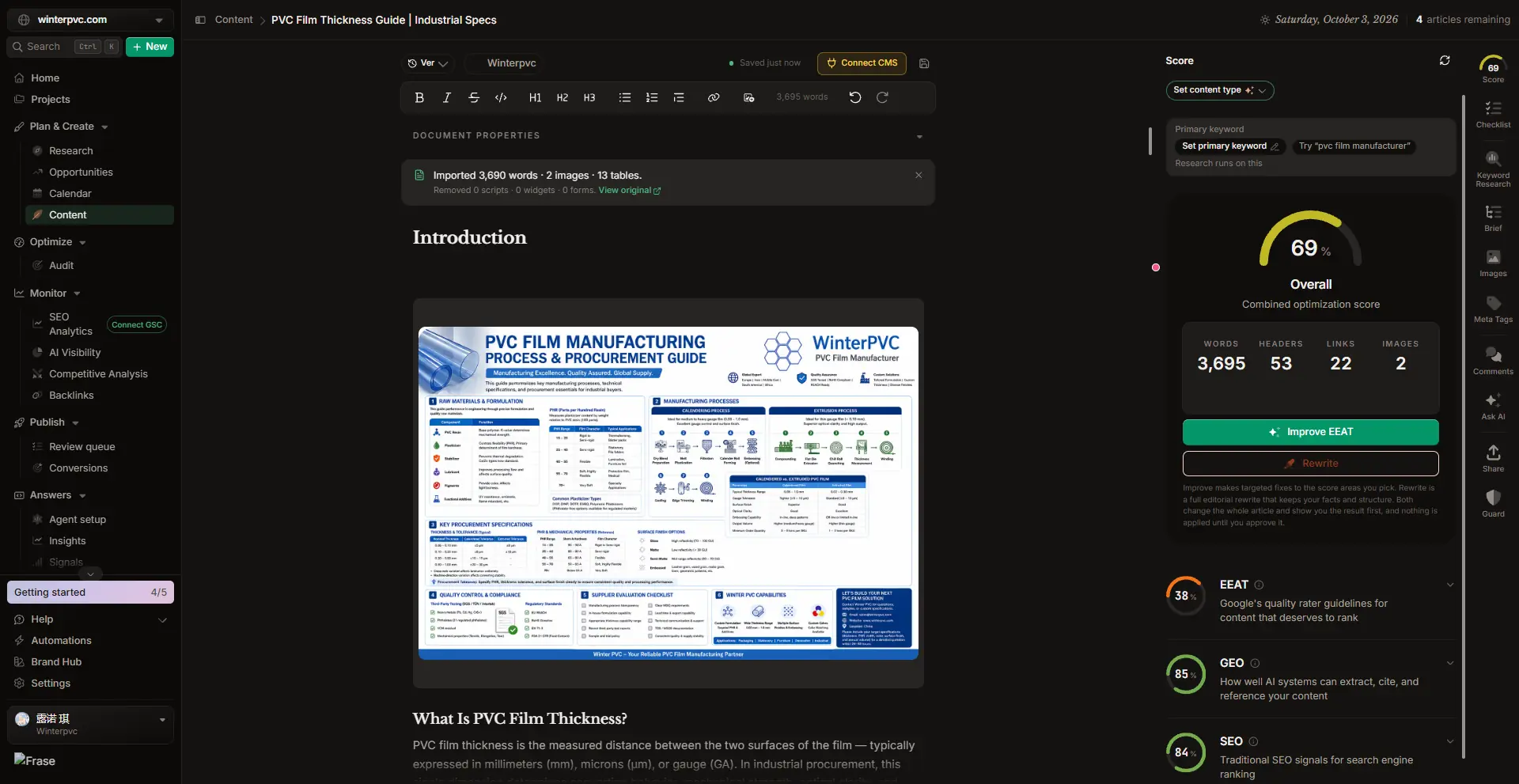
2. How they phrase their advice — and how each one can mislead you. Surfer hands you an entity list: opaque PVC film, vinyl film, thermoplastic material, shower curtains. Frase hands you SERP-derived “topics to cover” and “questions to answer”.
Frase’s version has a specific failure mode in my niche. Its topics included things like “0.1mm Green Rigid PVC Film”, “Photo Frame Protective Film PVC Sheet Colorless Acrylic” and “More Products From This Seller” — these are e-commerce product listings, not the things a B2B manufacturer’s guide should cover. One of its suggested questions was “Any ideas where to get thick rigid sticker paper?”, which is a forum question, not a section for a manufacturer’s guide.
My conclusion: when suggestions are driven by the SERP, they get distorted for a manufacturing site, and a human still has to filter them. That’s a different failure mode from Surfer’s entity list — one is too narrow about structure, the other is too broad about intent.
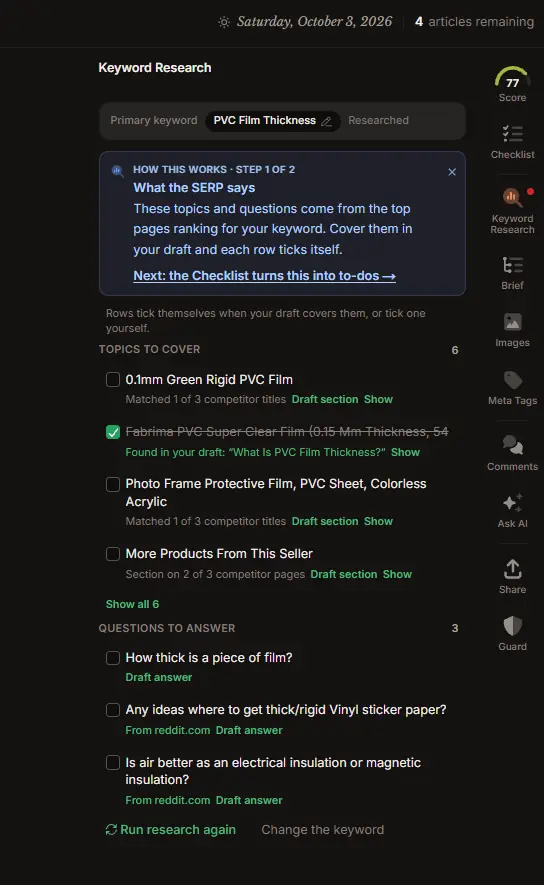
3. The brief and its “key facts” feature. Frase automatically pulled facts out of my existing article: “PVC film thickness is the measured distance between the two surfaces of the film”, “1 mm = 1,000 microns”, “0.05 mm / 50 microns / 200 gauge is used for light stationery overlay and document lamination”.
Whether that’s useful depends on what you’re doing. For a new draft — the use case most Frase reviews focus on — it’s a fast starting point. For an existing page, it’s largely rearranging what I already wrote. My honest take: helpful for a content team starting from zero, not a substitute for knowing your product.
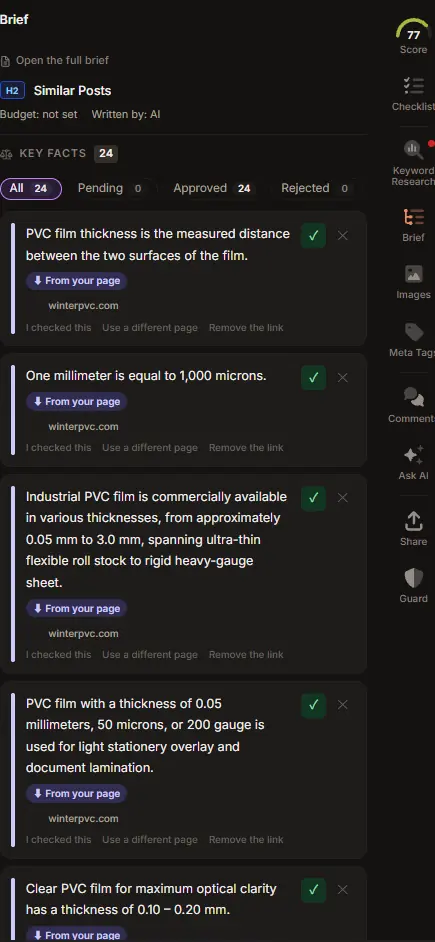
4. The extra diagnostics. One more finding worth reporting in this Frase review: meta tags 75%, structure 100%, readability 75%, link authority 50%. Surfer doesn’t list anything like these. For a content team they’re useful signals — but they’re directional, not decisive, and I wouldn’t rebuild a page around them alone.
Why I can’t tell you which tool caused the ranking movement
The page moved from position 53 to 8 across the months I was tracking it. I can’t attribute that to Surfer, and I certainly can’t attribute it to Frase. Here’s why:
- Google Search Console reports over overlapping rolling windows. Two three-month snapshots overlap by two months, so “before and after” is partly the same data.
- I didn’t keep a change log of what I edited with Surfer. If it isn’t written down, it can’t be measured.
- Both tools were used on the same page, so their effects can’t be separated.
- The site is new, and new pages climb on their own. I’ve watched a different page go from position 53 to 8 with almost no text changes at all.
- AI Overviews add impressions that have nothing to do with traditional rankings — mine went from 209 to 497.
There’s one more asymmetry worth stating plainly: the page Frase analyzed is already the Surfer version. Surfer’s recommendations shaped the article you’d see today. So Frase wasn’t answering “what should this page be?” It was answering “what’s still missing from it?”
So I’m comparing what the tools told me to do — not what I can prove they did.
Pricing and who each tool actually suits
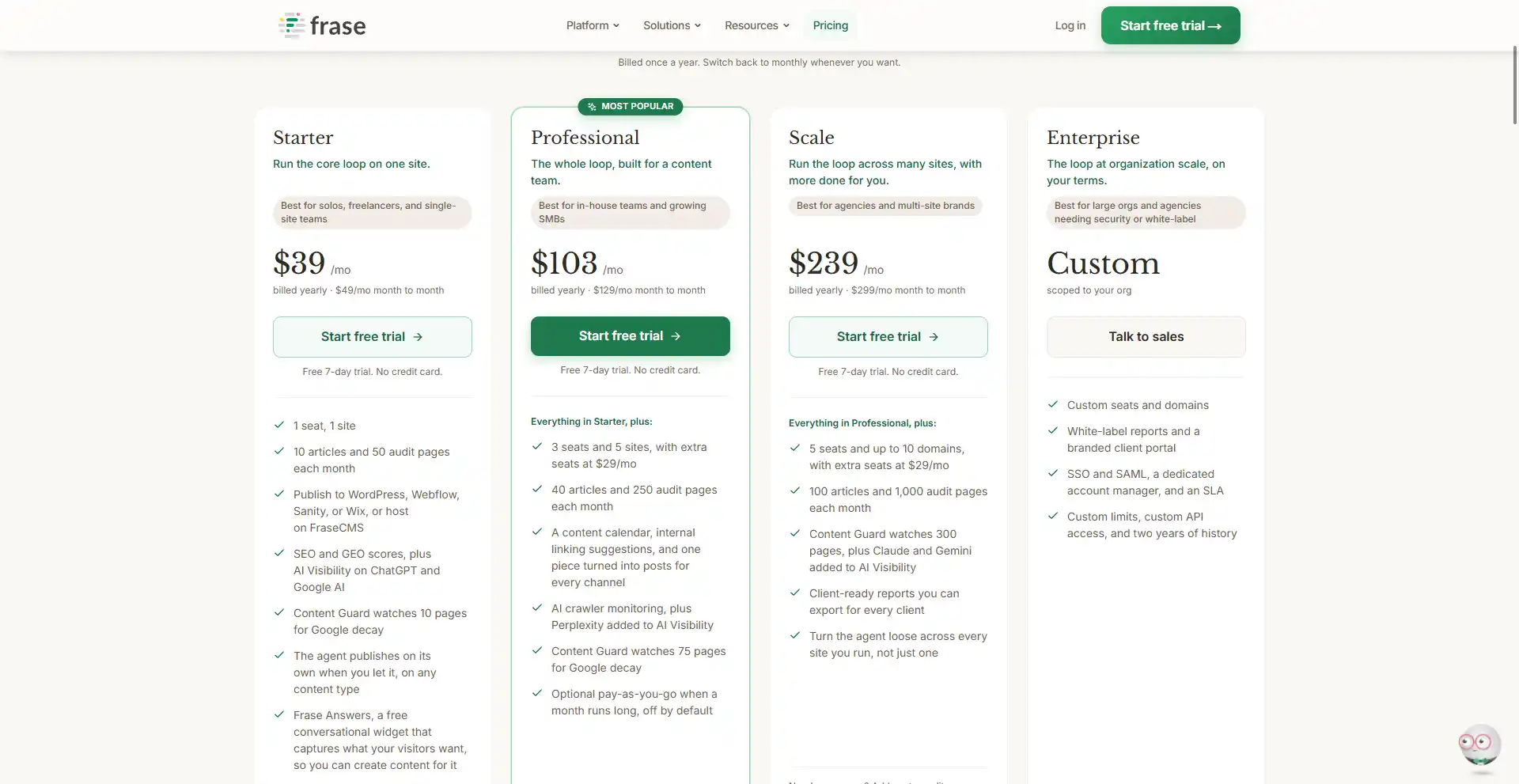
Frase’s plans are billed either yearly or month-to-month. At the time I checked: Starter $39/month billed yearly ($49 month-to-month), Professional $103/month billed yearly ($129 month-to-month), Scale $239/month billed yearly ($299 month-to-month), and Enterprise is custom-scoped. There’s a 7-day free trial and no credit card required, which is enough time to run its audit and one document on your own site — which is what I’d recommend doing before paying for either tool. If you want to check the current numbers yourself, they are on Frase’s pricing page.
My judgment from this Frase review, based on one page:
- Frase fits better if you run a content team or multiple sites, care about AI/GEO visibility, and want a content calendar and site-level auditing.
- Surfer fits better if you’re optimizing a single page deeply, comparing keyword coverage against competitors, or working with a limited budget on one or two pages.
It isn’t which one is better. They sit in different places in the workflow, and the useful question is which one your bottleneck is.
Conclusion
One more thing this Frase review confirmed: every AI SEO tool needs a human filter. Frase gave me a dead competitor domain and a fresh-keeping film company as an 85% match; it also told me something no other tool had — that my real weakness is EEAT at 38%, not keyword coverage.
A rating breakdown is more useful than a single score, because it tells you which problem to solve. But neither number replaces your own judgment about your own business.
Next step: I’ll keep using a change log and equal-length before/after windows, and I’ll test these tools again when I have a cleaner experiment to run. If you want to test it yourself, Frase’s 7-day free trial does not require a card.
Frequently Asked Questions
Is Frase SEO better than Surfer SEO?
There’s no single answer, because they solve different problems — and this Frase review only looks at one page. Frase leans toward site-level auditing, team workflows and AI/GEO visibility; Surfer leans toward deep optimization of a single page against the current SERP. On my page Frase gave a more useful diagnosis (EEAT 38% versus a healthy SEO score), while Surfer gave a more focused entity checklist.
Does Frase SEO work for a B2B manufacturing site?
Partly. Its onboarding correctly identified my business as a B2B industrial PVC film manufacturer, which was genuinely accurate. But its SERP-driven topic suggestions included e-commerce product listings like “0.1mm Green Rigid PVC Film” and “More Products From This Seller” — content a manufacturer’s guide should not chase. It works, but only with a human filtering the output.
Why did Frase recommend competitor domains that don’t load?
I don’t know, and Frase doesn’t explain it. What I can tell you is what happened: of four suggested competitors, two domains no longer resolved, and one was in a completely different industry. A high match percentage doesn’t verify that a site is live or relevant. Check every domain yourself before trusting the analysis built on it.
What is Frase’s GEO score?
It’s Frase’s estimate of how easily AI systems can extract, cite and reference your content. My page scored 85% for GEO while scoring only 38% for EEAT — a useful reminder that being quotable by AI and being trusted by Google are two different things.
Can you use Frase and Surfer SEO together?
Yes, and that’s what I’d do. Surfer is better for the drafting and optimization pass on one page, including entity coverage. Frase is better for auditing the whole site and showing you where the structural and authority problems are. Using one for the page and the other for the site is a reasonable split.
Did Frase improve your rankings?
I can’t claim that, and I’d be skeptical of anyone who does after a single month. My page improved, but the measurement windows overlap, I didn’t keep a change log, and both tools touched the same page. At best, each tool is one contributing factor among several.
If you want the full picture, start with the Surfer SEO review that kicked off this series, or read what changed one month later.