Surfer SEO Result From a Personal Blog: Real B2B Data After 3 Months
Quick Context: This is the first part of a three-part tracking note, published on my personal blog, BenchJournal. I ran three very different page types through the same Surfer SEO workflow — an informational blog post, a product page, and the homepage — and I’m writing down what each one actually did afterward, without dressing it up.
Page 1 — “What Is PVC Film?”: why I picked it and what I expected
“What Is PVC Film?” is the most classic informational page on the site: it explains what the material is, rigid versus flexible film, how the film is manufactured, where it gets used, and what certification/compliance issues a buyer should care about (the outline Surfer generated names EN 71, RoHS and REACH explicitly). It is the kind of page a potential customer reads early in their research, before they ever look at a product.
I chose it as the first experiment for two reasons. First, it sits at the top of a topic cluster — several product pages point to it and it points back to them — so whatever I learned here would carry over to the other two pages. Second, I deliberately wanted one page where I had modest expectations: an informational post rarely converts on its own, so I planned to judge it on visibility rather than clicks.
What the Surfer workflow actually pushed me to do
Surfer SEO is a SaaS tool that analyzes the top-ranking pages for a query and turns them into an editing checklist — the kind of thing content teams on B2B sites use so they stop guessing. I’ve covered the tool in depth in a separate Surfer SEO review, so here I’ll keep it practical: I ran the page through the Content Editor’s five-step flow — Research & Create Outline, Write & Optimize, Internal Links, Pre-Publish Review, then Publish or Export.
The most useful part was not the text suggestions. It was the running entity checklist. Surfer kept a list of terms and concepts that appeared across the top-ranking results for the query — opaque PVC film, vinyl film, thermoplastic material, and application categories like shower curtains, windows, packaging and furniture — and let me mark each one “covered” as the draft addressed it. That turned a vague “write a better article” task into a checklist, and it caught real gaps: for example, an explicit comparison of PVC vs. PET, and a dedicated FAQ (whether PVC film is waterproof, how PVC and PET differ, whether it can be customized, and how long it lasts). None of this was magic; it was structure and coverage discipline.
The honest caveat: the process is mechanical and takes time. What it gave me was a complete outline and a checklist, not better writing by itself. And in my case the workflow ran while I was publishing the page in pieces — I edited and went live as I worked through the steps, so there was never a single clean “rewrite shipped” moment.
What the real numbers show (page-level, from the Search Console export)
One note on method before the numbers: my first draft of this post used whole-property screenshots and treated them as page results. That was wrong. Pulling a URL-filtered export for what-is-pvc-film directly from Search Console (2026/06/07 to 2026/09/08) gave me the page’s own numbers, and they tell a different, less flattering story:
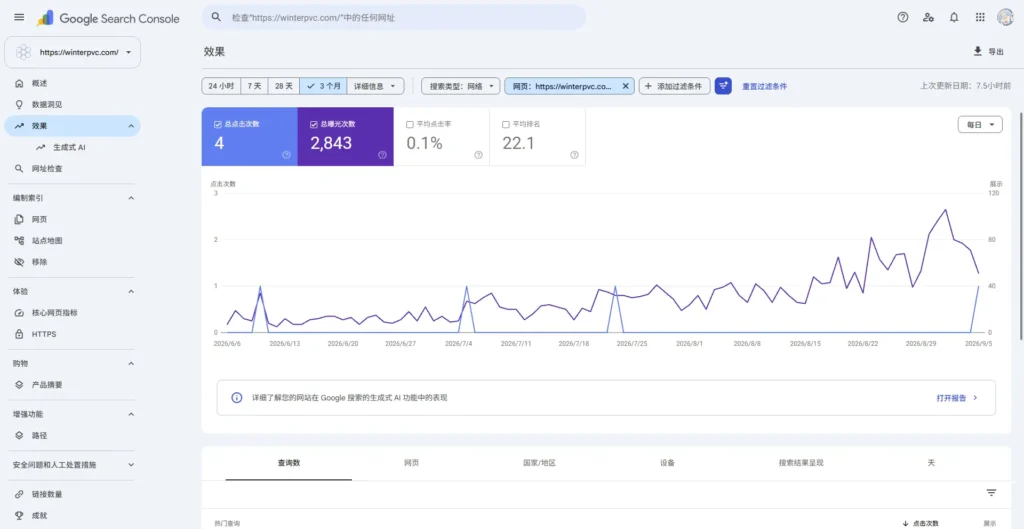
- Whole window: 4 clicks, 3,075 impressions, CTR around 0.13%, average position around 20.9.
The first three months, month by month
Broken down by month, the trend is clear — visibility and position improved steadily the whole time:
- June (from 06/07): 302 impressions, 1 click, average position ~52.7.
- July: 741 impressions, 2 clicks, average position ~25.5.
- August: 1,408 impressions, 0 clicks, average position ~17.3.
- September (01–08): 624 impressions, 1 click, average position ~7.9.
In early June the page averaged around position 53 with roughly ten impressions a day. By early September it was around position 8 with roughly eighty impressions a day. On the surface, that is a dramatic improvement — the kind of screenshot people post as a win.
Here is the uncomfortable part: my Surfer rewrite of this page happened around 2026-09-08, published piece by piece as I worked. That means almost the entire measured window contains the pre-rewrite version of the page. The June-to-September climb mostly happened before my rewrite even existed. The page’s first impressions in Search Console date to 2026-06-07, which I’m treating as its effective launch baseline — which means this whole curve is roughly the page’s first three months of life. I can’t separate “a new page ramping up” from “content changes helping” inside that curve, and I’m not going to pretend I can. Anyone who tells you this climb proves the tool works is over-reading it — including me, in my first draft of this post. It’s also the main way this write-up differs from most Surfer SEO reviews you’ll find online, which tend to end at the ranking chart.
Why the page still only has four clicks
The second uncomfortable number is clicks: four. In three months. Even in early September, sitting around position 8 with decent daily impressions, the page earned zero clicks on most days. Its overall CTR is about 0.13%. The single biggest source of impressions was the broad query “pvc film” — roughly 1,300 of the ~3,000 impressions, with zero clicks. That pattern suggests the page is being seen by people who are early in research or looking for something generic, and its title and snippet are not earning the click when it does appear. I have hypotheses about why (title/description weakness, intent mismatch on head terms, a brand-new domain), but they are hypotheses, not conclusions.
What I think this experiment is actually showing, cautiously: for an informational page like this, direct clicks are a poor early success metric, and I was wrong to frame it that way. The job of this page is to be the thing other pages link to and to rank for research-stage queries. Position and impressions moving from 52 to 8 is real progress — but most of it predates my optimization, so the only honest headline today is: the page is trending up, I cannot claim credit for the trend, and the rewrite’s effect (if any) is measurable only from 2026-09-08 onward, which at the time of writing is only a few days of data. I’ll publish the post-rewrite numbers in a follow-up as that window grows — and if you want an early read on what actually changed right after publishing, my check-in nine days after optimizing with Surfer SEO is the first of those.
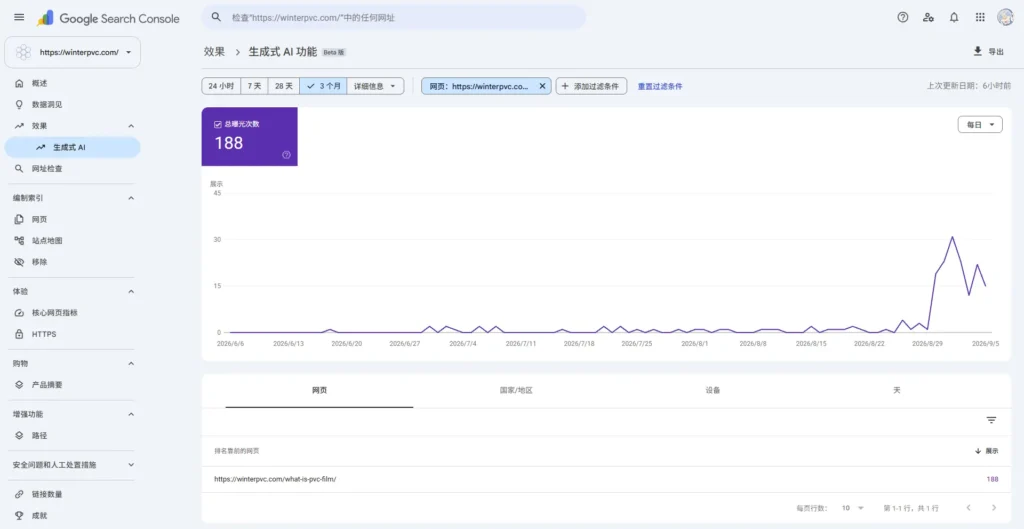
I will keep taking monthly page-level snapshots from here. Separately, this page does show up in Google’s AI Overviews — I’ve written a separate post on what a handful of AI Search impressions can mean for a small B2B page. But I haven’t set up formal tracking for that yet, so I’ll cover it properly in a follow-up rather than try to read a trend from a couple of snapshots.
Product page and homepage: where they stand
The second experiment is the Super Clear Film product page, optimized in the same workflow. Its page-level export is available now: first impressions on 2026-06-12, and so far 1 click and 93 impressions — an even quieter baseline than this page’s. The full case will be its own follow-up post.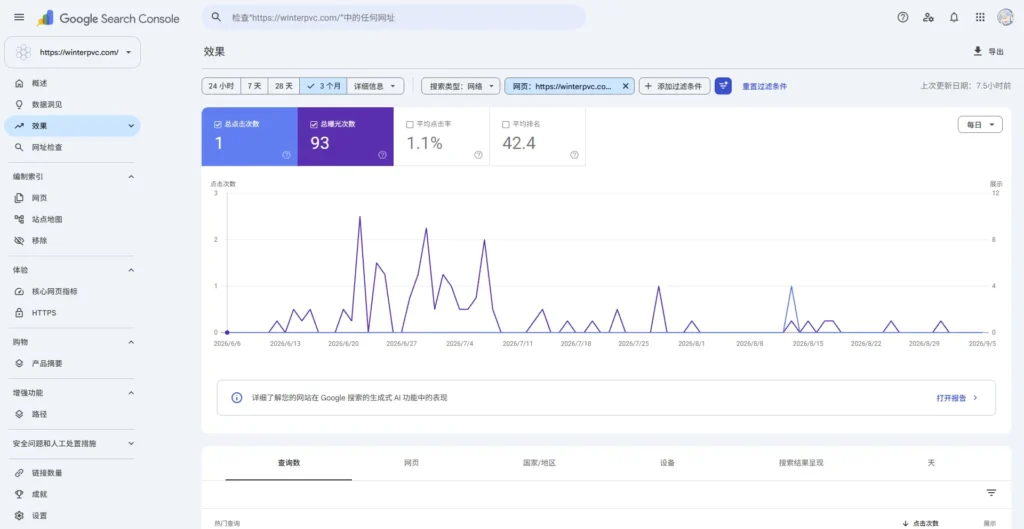
The third is the PVC Film Manufacturer homepage. For context, its trailing-12-month export currently shows 5 clicks and 75 impressions — essentially no organic visibility yet, which makes it the most honest “before” baseline of the three. The full homepage case will follow in a later part.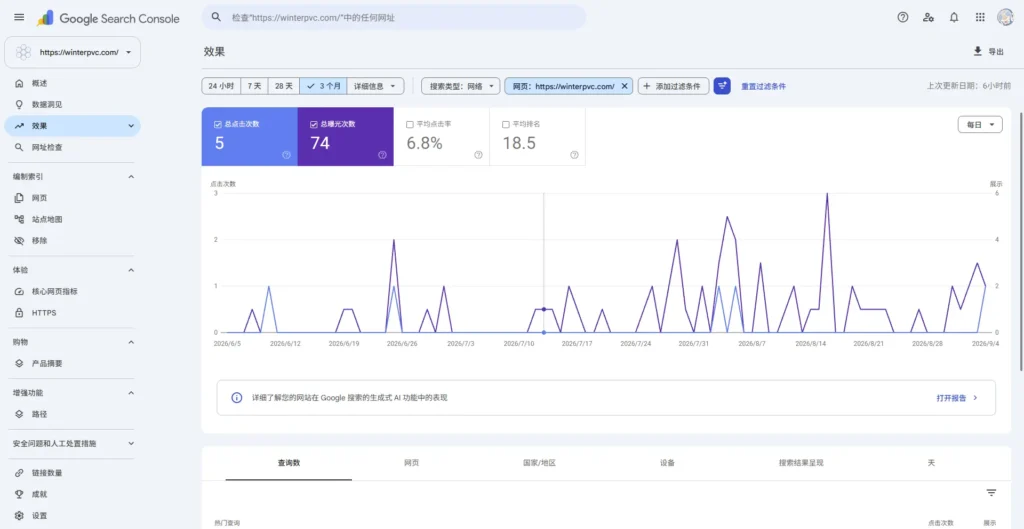
I will update this post as those windows close out. Judging by this first page, the honest headline so far is: the page is getting seen more and ranking better over time, clicks are still near zero, and I cannot yet prove that my optimization caused any of it.
Frequently Asked Questions
A few questions I keep getting about this experiment, answered directly:
Did Surfer SEO cause the ranking improvement on the What Is PVC Film page?
I cannot claim that. My rewrite of the page happened around 2026-09-08, so almost the entire measured window contains the pre-rewrite version. The climb from an average position of about 52.7 in June to about 7.9 in early September mostly happened before the rewrite existed, and I cannot separate a new page ramping up from content changes helping.
Why does the page have so few clicks if its position improved so much?
Over three months it earned 4 clicks against roughly 3,075 impressions, a CTR of about 0.13%. The single biggest source of impressions was the broad query “pvc film”, about 1,300 of the roughly 3,000 impressions, with zero clicks. The page appears to be seen by people early in research, and the title and snippet are not earning the click.
What was the most useful part of the Surfer SEO workflow?
Not the text suggestions but the running entity checklist. Surfer kept a list of terms and concepts that appeared across the top-ranking results and let me mark each one as covered as the draft addressed it, which turned a vague instruction to write a better article into a checklist and caught real gaps such as an explicit PVC versus PET comparison and a dedicated FAQ.
How should page performance be measured?
With a URL-filtered export for that single page from Search Console, not with whole-property screenshots. My first draft of this post used whole-property screenshots and treated them as page results, which was wrong, and the URL-filtered export told a different and less flattering story.
Where are the product page and homepage experiments?
The Super Clear Film product page has 1 click and 93 impressions so far, with first impressions on 2026-06-12. The PVC Film Manufacturer homepage shows 5 clicks and 75 impressions over the trailing twelve months. Each of those will be its own follow-up post.